Buy the Award-Winning Book Here (over 800 copies sold, as of January 2025)!!!!
Read the Introduction Chapter: What’s Racism Got To Do With It? Black Women & Girls, Sexual Abuse, & Liberation
I am NOT recruiting PhD students in BUSSW for Fall 2026.
Affiliations & Roles
I am an Associate Professor at Boston University School of Social Work (BUSSW), Clinical Practice Department, Faculty Affiliate at BU’s African American & Black Diaspora Studies, and Faculty Affiliate at BU’s Center for Innovation in Social Work & Health. I am the Treasurer of the Board of Directors and Chair of the Finance Committee (2026 – present), co-chair in the Inclusion, Diversity, Equity, & Accessibility [IDEA] Board Working Group, and member of the Scientific Committee, Nominating Committee, Audit Committee, and Annual Conference Committee at the International Society for the Study of Trauma & Dissociation (ISSTD). I am also a member of the Advisory Committee of the National Academies of Sciences, Engineering, & Medicine (NASEM) Action Collaborative on Preventing Sexual Harassment in Higher Education. Additionally, I am on the Board of Directors and the Chair of the Research Advisory Committee of the Center for Institutional Courage, as well as on the Board of End Rape On Campus (EROC). Finally, I am a Faculty Affiliate in Dr. Margaret Hicken’s University of Michigan Institute for Social Research (ISR) Transdisciplinary Approaches to the Study of Racism & Health Inequalities (RacismLab).
I am a former Stanford University CASBS Fellow (2021-22), MCUAAAR Research Scientist (2020-21), Ford Fellow (Dissertation, 2015-16; Postdoctoral, 2018-19), National Academy of Sciences (NAS) Kavli Fellow (2019), co-editor of the special issue of Journal of Trauma & Dissociation—[JTD] Self Injury & Suicidality: The Impact of Trauma & Dissociation (2015), lead co-editor of the special issue of JTD, Discrimination, Violence, & Healing in Marginalized Communities (2021), and lead co-editor of the upcoming special issue of JTD, Understanding, Preventing, & Healing Dissociation in the Context of Intersecting Inequalities. I am additionally on the Editorial Boards of JTD, Journal of Clinical & Child Adolescent Psychology, and Psychological Science. I also contributed to the NASEM Proceedings of a Workshop: Evaluating the Effectiveness of Intervention to Prevent & Address Sexual Harassment (National Research Council, 2021). Finally, I am the author of The Cultural Betrayal of Black Women & Girls: A Black Feminist Approach to Healing from Sexual Abuse (American Psychological Association; 2023), which won the 2024 Frank W. Putnam Outstanding Book Award from the ISSTD.
Education
I graduated summa cum laude with a B.A. in psychology from San Diego State University (2011), having additionally received undergraduate education from City College of New York and San Diego Mesa College.
Following my M.S. in 2012, I earned my Ph.D. in clinical psychology from University of Oregon in 2017.
In that time, I completed my American Psychological Association (APA)-accredited clinical internship at the Charleston Consortium Psychology Internship Training Program at the Medical University of South Carolina (MUSC) & Department of Veterans Affairs in the Traumatic Stress Track (2016-17).
Lastly, I completed a postdoctoral fellowship in the Wayne State University Postdoctoral to Faculty Transition Fellowship (PFT) Program at the transdisciplinary research institute, the Merrill Palmer Skillman Institute for Child & Family Development (MPSI) in 2019.
Research
As a Black feminist and critical race scholar, my research focuses on the effects of interpersonal trauma and violence (e.g., physical, sexual, and emotional abuse) in diverse populations. In proposing cultural betrayal trauma theory, I include interpersonal trauma in conjunction with discrimination to examine mental, physical, behavioral, and cultural health outcomes.
For example, in cultural betrayal trauma theory, I propose that if a Black girl is sexually assaulted by a Black man, the outcomes of this cultural betrayal trauma, such as dissociation, suicidal thoughts, and internalized prejudice, are impacted by both people experiencing discrimination in society.
With cultural betrayal trauma theory, I examine the differential impact of inequality for marginalized youth, young adults, middle aged adults, and elders who experience trauma. With this research, I hope to both document harm and identify avenues of hope and healing for youth, families, communities, institutions, and society.
My short article from The Conversation: The Unique Harm of Sexual Abuse in the Black Community, explains CBTT for a general audience (over 642,000 readers as of September 2025).
For more information, see my Research, Grants, HOPE Lab, Cultural Betrayal Trauma Theory, and The Book sections of my website, as well as in my Curriculum Vitae.
Book
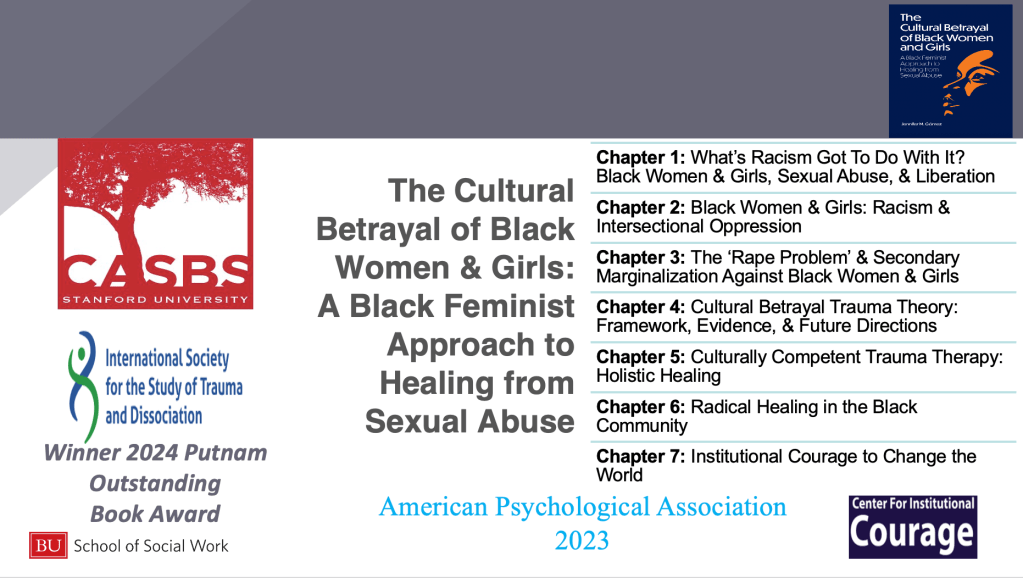
As a CASBS Fellow at Stanford University (2021-22), I wrote my first book- The Cultural Betrayal of Black Women & Girls: A Black Feminist Approach to Healing from Sexual Abuse (2023; Publisher: American Psychological Association; winner of the 2024 Frank W. Putnam Outstanding Book Award from the ISSTD). This is the first book to use the cultural betrayal trauma theory (CBTT) research to contribute to academic and national discussions regarding anti-Black racism and sexual violence. Following synthesizing the transdisciplinary research and scholarship on structural racism, intersectional oppression (chapter 2), sexual abuse in the Black community (chapter 3), and CBTT (chapter 4), this book provides implications for culturally competent trauma therapy (chapter 5), radical healing in the Black community (chapter 6), and institutional courage to change the world (chapter 7).
Filmed January 2022, I discuss the content of the book and my writing process in Cultural Betrayal & ‘Conundrums’: The Making of a Book, at the BUSSW Equity & Inclusion Speaker Series.
For more information on the book, including a free sample chapter, see my HOPE Lab and The Book sections of my website.
Research Dissemination
2,400+ Google Scholar Citations, h-index 28, i10-index 41 (as of December 2025); ORCiD: 0000-0003-3580-4634
I aim for my research (detailed above and in theCultural Betrayal Trauma Theory , HOPE Lab , The Book sections) to have an impact both within and outside of academia. As a result, I have published over 100 peer-reviewed journal articles (45+), book (1), book chapters (10+), scholarly writings (5+), pieces for the general public (30+), and educational/professional development documents (30+) published in outlets including in:
Peer-Reviewed Journals
- Sex Roles: A Journal of Research
- Journal of Child & Adolescent Trauma
- Journal of Child Sexual Abuse
- Violence Against Women
- Journal of Trauma & Dissociation
- Journal of American College Health
- Journal of Black Psychology
- American Journal of Orthopsychiatry
- Journal of Immigrant & Minority Health
- Transcultural Psychiatry
- Perspectives on Psychological Science
- and others…
Books
- The Cultural Betrayal of Black Women & Girls: A Black Feminist Approach to Healing from Sexual Abuse
- Interpersonal Violence: The Social Work Response
- Handbook of Interpersonal Violence Across the Lifespan
- Macmillan Encyclopedia of Intimate and Family Relationships: An Interdisciplinary Approach
- Sexual Boundary Violations in Psychotherapy: Facing Therapist Indiscretions, Transgressions, and Misconduct
- Trayvon Martin, Race, and American Justice: Writing Wrong
- Presumed Incompetent II: Race, Class, Power, & Resistance of Women in Academia
- and others…
Newspapers/Magazines
- Inside Higher Ed
- The Conversation
- The Hill
- Blavity
- and others…
- So You Want To Write An Academic Book? Lessons From A Junior Faculty Member In A Non-Book Writing Field
- How To Give An Engaging Talk
- Self Care And Longevity In Research And Clinical Work Regarding Trauma And Inequality
- Preparing For Tenure At An R1 University: Insight On The Packet And The Process From A Pre-Tenured Female Professor Of Color
- Anti-Black Racism Resources
- Related Evidence Of Bias In Tenure And Promotion…And Solutions To Fixing It
- Need For Anti-Racism In Policy Design And Implementation: Response To Potential Trend Towards Requiring CLAS (Psych) Faculty To Externally Fund Their Graduate Students’ Stipends, Tuition, & Benefits
- Compilation Of Tenure Track Faculty Phone/Videoconference Interview Questions From The Social Sciences For R1 Universities
- Tips For Writing For The General Public
- and others…
I have additionally contributed research perspectives on violence, sexual abuse & harassment, racism, and sexism in national news outlets, including in The Lily, a product of Washington Post, NBC News, Huff Post, Newsweek, Forbes, and others. Finally, I have given over 150 research presentations locally, nationally, and internationally at conferences, other universities, and community organizations, including the United Nations (UN) Commission on Narcotic Drugs (CND) Side Events, Stanford University, University of Michigan, University of Toronto, UC Berkeley, ISSTD, BBC Woman’s Hour, Motor City Singers Space, Detroit Public Schools via Michigan Opera Theatre, and more.
More information in my CV, Public Scholarship, & In The News sections of my website.
Awards/Honors
Select RESEARCH Awards/Honors:
- 2025 Linda Saltzman Memorial Intimate Partner Violence Researcher Award from the Institute on Violence, Abuse, & Trauma (IVAT) (Gómez)
- Honorable Mention for Richard Kluft Award for Journal of Trauma & Dissociation 2024 Best Article for “It will always feel worse because it comes with that added ‘betrayal’”: Intersectionality praxis and Black young women survivors’ perspectives on cultural betrayal trauma theory. (Gómez & Gobin, 2024)
- 2024 Frank W. Putnam Outstanding Book Award from the ISSTD for The Cultural Betrayal of Black Women & Girls (Gómez)
- 2021-22 CASBS Fellowship at Stanford University to write The Cultural Betrayal of Black Women & Girls (Gómez)
- 2022 Outstanding Contribution Award in Training and Education in Professional Psychology (TEPP) presented by the Association of Psychology Postdoctoral and Internship Centers (APPIC) for Who are we missing? Examining the Graduate Record Examination quantitative score as a barrier to admission into psychology doctoral programs for capable ethnic minorities (Gómez, Caño, & Baltes, 2021)
- 2021 American Psychological Association (APA) Division 35, Section 1 Carolyn Payton Early Career Award for Black Women & Girls and MeToo: Rape, Cultural Betrayal, & Healing (Gómez & Gobin, 2020)
- American Public Health Association (APHA) Aging & Public Health Section 2020 Betty Cleckley Minority Issues Research Award (Byrd, Gómez, & Ficker)
- 2020 APA Division 56 Award for Media Contributions to the Field of Trauma Psychology for Encouraging Bravery & Fortitude In Dismantling The Insidious Stronghold of Racism , published in The Hill (Cook & Gómez)
- 2017 American Psychological Association (APA) Division 56 Award for Outstanding Dissertation in the Field of Trauma Psychology: Cultural Betrayal Trauma Theory (Gómez)
- Richard Kluft Award for Journal of Trauma & Dissociation 2016 Best Article for Shifting The Focus: Nonpathologizing Approaches to Healing From Betrayal Trauma Through An Emphasis on Relational Care (Gómez, Lewis, Noll, Smidt, & Birrell, 2016)
- Top 10 Most Cited Article of 2016 in Psychological Trauma: Theory, Research, Practice, & Policy for Are Hallucinations Related to Betrayal Trauma Exposure? A Three-Study Exploration (Gómez, Kaehler, & Freyd, 2014)
- 2020 Wayne State University Academy of Scholars Junior Faculty Research Award (Gómez)
TEACHING Award:
SERVICE Honors:
- 2020 Metro Detroit Association of Black Psychologists Certificate of Appreciation as Board Member: Cultural Liaison (Gómez)
- Wayne State University Certificate of Appreciation for Efforts in Building an Inclusive Community (Gómez)
COMMUNITY ENGAGEMENT Honor:
- 2010 San Diego Domestic Violence Council Certificate of Excellence for Personal Commitment, Dedication, and Performance (Gómez)
More information in my CV and Awards/Honors section of my website.
Teaching, Advising, & Mentoring
Teaching, advising, and mentoring junior scholars are high priorities for me (for resources I make publicly available, see my Current Students, Prospective Students, & HOPE Lab sections of my website; the Gómez HOPE Lab Professional Development Series; the Gómez Social Justice & Institutional Change Collection). Therefore, I am honored to have been chosen by MSW students as the recipient of the 2025 BUSSW Teaching Excellence Award.
I have been fortunate to work with many amazing students. From formal teaching evaluations and informal feedback I have gathered: below are comments from students in my HOPE Lab, graduate classes, and undergraduate courses at Wayne State University, where I was an assistant professor (2019-2022), and graduate classes at Boston University (2022-present).
HOPE Lab (Wayne State University):
- The HOPE lab meetings have been a wonderful opportunity to think creatively about research and gain perspective… Dr. Gómez does an excellent job of including people (faculty and students) and allows discussions to be uninhibited while holding structure to meetings. I would definitely seek professional advice from Dr. Gómez given her professional work, perspective, and demeanor toward myself and others. Without a doubt, my HOPE lab interactions and interactions with Dr. Gómez have been some of the most thoughtful and reenergizing experiences during my time here at Wayne State…
- Dr. Gómez is one of a kind and really takes a unique and proactive approach to mentorship, teaching, and overall education of…grad students…
- These meetings are one of my favorite, most valuable and enriching parts of this program.
- In the meetings…I feel like I sit there and am unpacking a lot as the meeting goes on, but I always leave incredibly rejuvenated and validated. These are amazing, thank you!
- Dr. Gómez is an excellent, inspiring, and efficient professor. The topics she picks are always relevant and useful for real world application, and the materials are organized and easy to understand. The meetings are set up to be inclusive and safe spaces to discuss sensitive topics and Dr. Gómez does an amazing job of educating us students and I always feel enthusiastic and rejuvenated/excited to do research after leaving her meetings. I would take any class taught by her and would recommend other students to attend.
Graduate Course (Advanced Trauma Seminar- Boston University):
- No other professor had as much influence, mastery, and positive impact in my future career in social work than Dr. Gómez. May her classroom style…be the foundation other classes should be modeled around.
- [Dr. Gómez’] case presentations were especially remarkable, and I appreciated the opportunity to learn from a professional who is currently working in the field. It was invaluable to have such authentic conversations and gain a deeper understanding of the nuances of social work.
- The professor included content around betrayal trauma, cultural betrayal trauma, dimensions of healing, addressing systems within therapy, contextualizing mental health, and engaging in institutional courage. All of these topics were extremely helpful in deepening my understand of trauma. I also seriously appreciated how much generative dialogue occurred…
- The highlight of the class was undoubtedly the exceptional expertise and knowledge displayed by the professor. Her ability to provide in-depth feedback and analysis on a single comment was remarkable and truly enhanced our learning experience. Additionally, the professor fostered an environment of honesty and openness, which allowed for meaningful discussions and deeper insights into the subject matter. Overall, the class provided me with invaluable knowledge and skills that I can apply to my future academic and professional endeavors.
- I enjoyed the organizational aspects and the clear communication with Dr. Gómez about how we are doing and our feedback. I enjoyed interactive learning with videos, discussions, and hearing case studies.
- I enjoyed the readings (shocker!), the information, and the case consultations. Those consultations were absolutely phenomenal and aided a lot in my presentation of clinical skills to my colleagues.
- I enjoyed the significant amount of resources provided by the professor and the amount of support that was provided by the professor. Likewise, the diverse material that allowed us to gain greater insight on different communities and populations.
- I really loved this course. I am so glad to have crossed paths with Dr. Gómez and think she is very inspiring and a total role model. I feel she cares about us and listens to us as students…I…would encourage everyone to take one of her courses.
- This professor’s contribution to the class is invaluable, and her expertise in the topics of racism and trauma is undeniable. She not only possesses a wealth of knowledge but also creates a safe space for students to engage in candid and meaningful conversations. I appreciate her honesty and vulnerability in addressing difficult topics and challenging us to think critically about our assumptions and beliefs. Despite potential discomfort that some white students may have experienced talking about this subject, her approach has undoubtedly helped us to grow in our understanding of diversity and racial justice issues. Her dedication to creating a positive and enriching learning experience is evident in the hard work and effort she puts into her teaching….
- This class was genuinely amazing…
- Professor Gómez’ instruction, curriculum, and relational engagement with her students should be the standard by which all professors measure their own work with students…
- This is the best course I’ve taken at BU…
Graduate Courses (Ethics & Diversity – Wayne State University):
- Dr. Gómez is an excellent teacher, and I always looked forward to hearing about her experiences and receiving feedback from her.
- Jennifer was passionate, engaging, and very knowledgeable about the subject matter.
- I really appreciated the format of this course because it allowed for thoughtful discussion in the course as well as with our writing prompts. Dr. Gómez’ feedback each week was helpful and thought provoking. I also appreciated the ideas and resources she provided throughout the course to help guide our learning and growth as clinicians.
- This was one of the (if not THE) most thought–provoking courses I’ve taken here at WSU. I am extremely grateful for the opportunity to reflect and grow in a safe and supportive environment, which should be credited directly to Jennifer’s skill as a teacher.
Undergraduate Courses (Introduction to Statistical Methods in Psychology– Wayne State University):
- I liked that you encouraged us to do high–quality work but gave us the help we needed to achieve that.
- One of the few teachers at Wayne State to openly acknowledge our differences, and make our differing voices heard.
- Very respectful to all students and treated students with dignity and respect with any question or comment they may have.
- I appreciate you putting things into real–life scenarios, and for thoroughly explaining the material each week. I also appreciate you adjusting the workload for the pandemic and for being aware and empathetic with the stress of the pandemic. You were a great instructor and I wouldn’t change anything about the way you taught the course!
- One of the best professors at Wayne State! Dr. Gómez teaches material in a clear, concise manner. She is both professional and approachable. She is super kind and will help, and does not make her students feel bad. She is kind and empathetic, which is needed now more than ever.
Prior Career: Ballerina
Prior to attending college, I was a professional ballet dancer with Dance Theatre of Harlem.
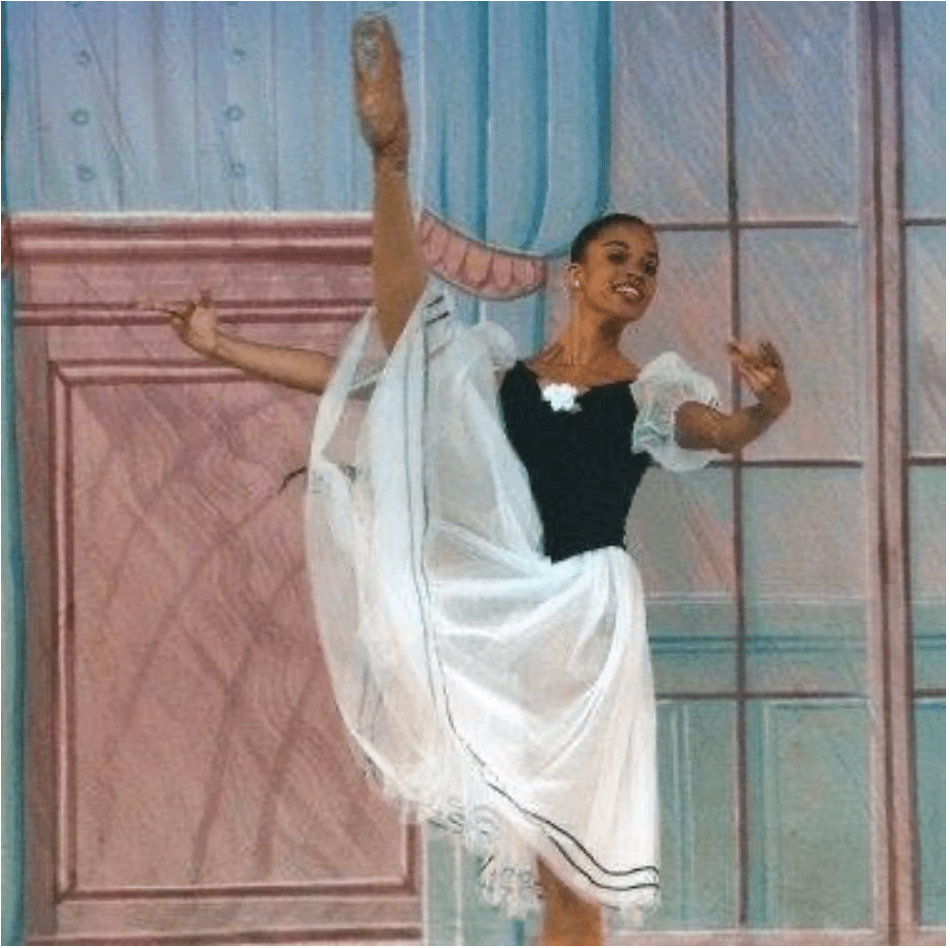
Count 9 Podcast: From Ballerina to Professor
Interviewed by Ben Goodly for his Count 9 podcast regarding the career transition from professional ballet dancer with Dance Theatre of Harlem to academic.
What I learned “…direct from Mr. {Arthur} Mitchell: buck against the system. Of just you cannot, cannot wait for things to be equal enough and for oppression to be eradicated. And wait for me to walk in the room as a Black woman and have people assume I’m a professor before I get up to speak. I cannot wait for those things to happen. I have to just do it anyways. And I think it’s the biggest lesson from him and then from what he’s done with Dance Theatre of Harlem, that you just do it anyways. And when you’re doing it anyways, change is happening. Things do become more equal by your presence of just kind of pretending that you belong and that people want you here. Even when you’re not sure that’s true, because of racism or sexism.”–Dr. Jennifer M. Gómez
September 2020
Resources
- Gómez Social Justice & Institutional Change Collection (2022), with handouts on anti-Black racism, faculty strategies for structurally supporting students, literature on bias in tenure and promotion, questions to ask on tenure-track faculty positions at R1 university campus visits, tips for writing op-eds, and more
- Gómez HOPE Lab Professional Development Series (2022), with handouts on faculty negotiations, self-care and ethics in trauma/inequality research, publishing research that centralizes inequality, how to give engaging talks, and more
- Advice For How Grad and Undergrad Students Should Interact with BIPOC Professors (Brown & Gómez, 2022)
- Understanding Structural & Institutional Racism FREE online course (Boston University School of Social Work–Belkin Martínez, Hamilton, & Toraif)
- Inclusivity, Honesty in Representation, & Celebrating Diversity: A Case Example with the UO Psychology Department Website (Gómez, 2016)
- Advice for Marginalized Students on Choosing a Ph.D. Program (Grollman, 2018)
- Productivity not Perfection (Selig, 2020)
- Allyship as Sustained Practice in Graduate School (Wayne State University Graduate Students: Tenbrink, Smith, LaMarre, Pineault, Lopez, & Christophersen, 2020)

 Jennifer M. Gómez, Ph.D.
You must be logged in to post a comment.